
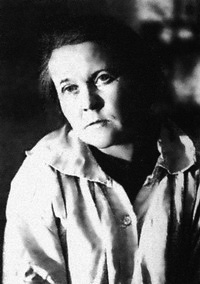
Because I have received no formal education in philosophy and art history (but had to attain everything on my own via reading and studying in museums) it is difficult for me to write this little addition and find suitable terminology. Nevertheless, because over my long life I have acquired an experience in this area I simply want to share my thoughts, in the hope that my learned friends will understand me and may later on help to discern the problems which I raised.
Since the primitives
and, in particular, the ancient Russian icons were discovered (by “discovered”
I mean not just “cleared from the newer layers of paint during restoration” but
“understood” and “valued”) and people began painting new icons in that discovered
“style” many make a mistake: they do not consider enough the vast diversity of
approaches to icon painting over centuries. To see what I am trying to say one can
compare the icon ‘Our Lady Vladimirskaya’ XII c. with ‘The Holy Trinity’ by
Rublev. Yes, there is the same principle there, but there is also an enormous
difference or at least huge.
And now
some of our contemporary iconographers (unfortunately, I live in isolation so know
very few), after choosing a particular single period in icon painting as a model
for imitation, consider all other attempts which differ from theirs as “not
icons” (or not canonical – A.T.).
Usually
those who nowadays are engaging in icon painting take for their example the
time when the style was already very well-developed and even over-developed,
being on the boundary with decadence and having much of the aestheticism
that I, to a degree, oppose to the religious content of an icon and to its sincerity.
Because this boundary is so very fragile it is even more dangerous to take such
a style (overdeveloped to the point of decadence) as an example and compass.
It seems to
me that the ancient epochs with their realism are much closer to our religious
psychology – I would not be afraid of the word “realism” here – but I must stop
to clarify its meaning and even more so the difference between symbolism and
stylization. Art in its very nature is symbolic and the icon, because of its task,
is even more symbolic (here one can speak about a kind of “real-symbolism”).
It is precisely when the icon departs from this real-symbolism as the method
of expression that it departs from its task or purpose.
