Showing posts with label Jesus Christ My Lord. Show all posts

Sunday, 11 September 2022

The Sacred Heart of Jesus

I first saw the statue of the Sacred Heart of Jesus in France, I think. Soon I was to see many of them; almost any Catholic church I went into would have one. Although I perceived that image as somewhat weird (for an Eastern Orthodox), with a three-dimensional heart sitting on the chest, I was drawn to it somehow.  

An Eastern Orthodox typically objects the devotion to the Sacred Heart on the grounds that a heart is a part of the body and we are devoted to the whole Christ (to venerate a bodily part is a kind of heresy some say). I must say the objection made a sense to me, although not for the theological reason but because the heart of Jesus, being venerated separately from Him, did not work for me psychologically. My attitude changed when I read the words of Christ addressed to St. Margaret Mary Alacoque (1647-1690, France) in a vision of Him with His heart being visible:

“Behold the Heart which has so loved men that it has spared nothing, even to exhausting and consuming Itself, in order to testify Its love; and in return, I receive from the greater part only ingratitude, by their irreverence and sacrilege, and by the coldness and contempt they have for Me in the Eucharist.”
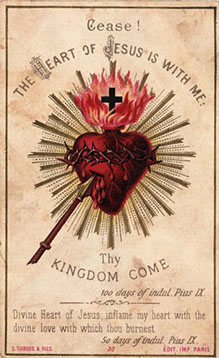


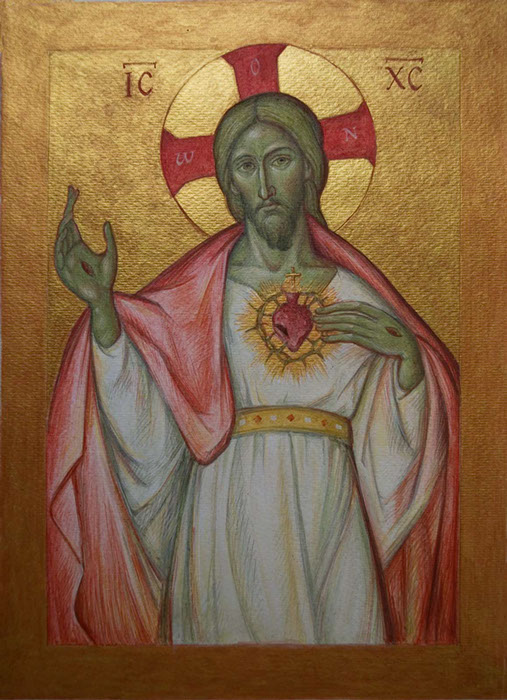
Then I understood that the Heart depicted outside of the body, pierced and squeezed by the Crown of Thorns, with the Cross on the top of it aflame and with the rays of light coming from it is simply a symbolic expression of the emotional suffering of the Son of Man caused by His love for us and not just that –
it is an invitation to the painfully (for the human with a heart) real relationship with Him. It is a symbolic expression of the Love of God Who suffers because His Sacrifice, made out of His burning love for the humanity, has been rejected, mocked, ignored or otherwise abused by most. It is an utmost expression of the vulnerability of God, God Who can be vulnerable only in Incarnation.[2]

Precisely because in the Person of Christ both Man and God are vulnerable it is so important for the statue of the Sacred Heart not to be sweetly sentimental, I think. Far from conveying “sweetness”, it is supposed to convey the pain of the Man and the pain of God Who has exhausted all means for winning the love of His creatures and yet is still being denied by so many. There is nothing left; God died so that men could live and nothing can be added to that fact. One can detect an anger in the words of Christ to St. Margaret Mary Alacoque – again, very understandable anger at the loss of the souls and possible relationships – all that despite the bloody Sacrifice.
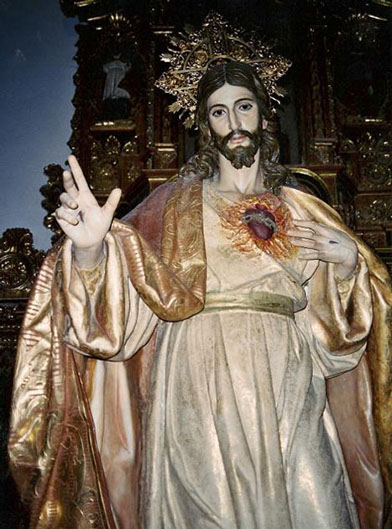


I would like to highlight a very human aspect of the message given by the Son of Man to the French mystic. It is entirely normal, for a human psyche, to love and to desire reciprocal love; it is normal, when one loves someone, to wish for them all possible good and to try to save them from a mortal danger; it is normal to be beside oneself if one sees that the other is turning his back on the sacrifice which is also the means of their salvation from the eternal death. Finally, it is normal, for a normal man, to reveal his vulnerability, to risk, stating his love and revealing his pain at the loss. Yes, Jesus as He is depicted on the image of the Sacred Heart is risking to bring even more mockery and spite upon Himself – if He is God how can He be like that? Isn’t God is supposed to be far above, not “needing” anything, not heartbroken or at least not exposing Himself like that?

Friday, 21 May 2021

An iconographer must be shot first

This little paper is the result of being requested to write “a short piece that brings Christ alive for us [Westerners] in the icon”. I deliberately quoted the exact words because they provide “a springboard” into what icon is, what is not and what to do with it.

I cannot fulfill the request “to bring Christ alive for someone”. Objectively speaking, Christ does not need to be brought alive because He is alive, He is the Life itself. “Come and drink all of you who are thirsty, from the Source of immortality”. Yet, subjectively/paradoxically Christ is dead for all who do not wish to relate to Him. Hence, I am unable to make Him alive for anyone (including on an icon) no matter how eloquently I speak of Him or of the mystics who loved Him or of how “lively” I paint Him. Ultimately, it is between Christ and the soul. Jesus Christ becomes alive for someone in the moment when someone turns to Him in response, as a person to the Person (very much like to another human being). This is what the icon is for – being a representation of the Person (of Jesus Christ or His Mother or a Saint) it invites a response from the other. And an icon is an invitation to the most intense personal relationship imaginable, the witness of what Christianity is all about. I have not read about that elsewhere but I feel that an icon is the essence of what personhood is, the essence which is possible to depict using symbolic realism (an icon is both realistic and symbolic).


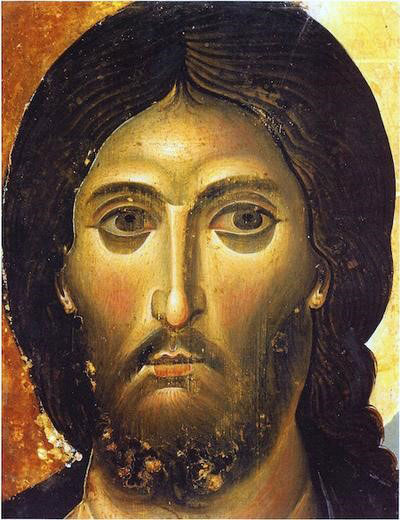
Christ Pantocrator, icon, Saint Catherine's Monastery, Sinai, 13 c.

Friday, 17 April 2020

Транслируемый Христос


Граффити

Несколько лет назад во время поездки, задуманной как паломничество по местам св. Иоанна Креста, я искала то место, где св. Иоанн был заключен в темницу своими же собратьями-монахами. Слово “собратьями” означает, что монахи принадлежали, как и он, к Ордену Кармелитов; вина св. Иоанна состояла в том, что он вместе со св. Терезой Авильской проводил реформу Ордена, пытаясь очистить его от разнообразных “вольных” практик и послаблений, приобретенных за время его распространения по средневековой Европе (корни Ордена Кармелитов на Востоке; первые отшельники селились на горе Кармель, отсюда и имя Ордена). Св. Иоанн провел девять месяцев запертым в пространстве размером чуть больше, чем гробница; каждую пятницу монахи извлекали его оттуда и жестоко избивали. В конце концов, когда он уже был близок к смерти, ему удалось бежать.

Св Иоанн Креста очень важен для меня; он был первым католическим мистиком, которого я открыла для себя и его сочинения научили меня обращаться к Христу как к личному Христу, интимному Христу или к Христу-Личности. Именно поэтому я поставила цель найти и увидеть места в Испании, связаные со св. Иоанном и была очень рада, обнаружив незаметную табличку, обозначавшую ничто, пустое место (в настоящее время часть детской площадки) объявляющую, что именно здесь св. Иоанну удалось сбежать из тюрьмы, пулоголому, т.к. его ряса истлела, но с прекрасной любовной поэзией, которую он написал, сидя в своей гробничной темнице. Помню, что я даже попыталась прочесть на память его поэму на том месте, просто от восторга, что я здесь; в том же состоянии душевного подъема я начала спускаться по лестнице и внезапно заметила сатанинский символ, дьявола, нарисованного черной краской на золотисто-песочной ступени. Естественно, я почувствовала отвращение и гнев; “они загаживают все, что только можно”, подумала я. Мне было ясно, что “они” отлично понимали значение св. Иоанна Креста и его поэзии, которая вся о любви к Христу, Возлюбленному души. Даже если суть этой любви была недоступна их пониманию, “они” совершенно точно понимали, что св. Иоанн свидетельствовал об ощутимой реальности личных отношений с Христом.

Я вспомнила о том эпизоде в Толедо, когда я увидела фотографию (см. ниже) граффити с сатанинским символом, перевернутым вверх ногами Kрестом, на двери католического собора в Мельбурне – того самого собора, в котором кардинал Пелл, согласно обвинению, подверг сексуальному насилию двух мальчиков-хористов. Граффити появилось после того, как Пелл был отпущен на свободу, а обвинения отменены; оно говорит “no justice”, “нет справедливости”.


Я увидела это граффити и совсем не почувствовала себя оскорбленной. Более того, я произнесла “да, так оно и есть” –  а затем внезапно вспомнила свое собственное “граффити”, кукольное представление, который я сделала после того, как я сама прошла через эмоциональное насилие или абьюз в Римско-Католической Церкви.

Friday, 10 April 2020

Streaming Christ


The graffiti

Years ago, during my trip to Spain made as a pilgrimage to St John of the Cross I was looking for the place where St John was imprisoned by his fellow monks. “Fellow” means that the monks belonged to the same Order of Carmel; the guilt of St John was that he, together with St Teresa of Avila, was pushing the reform of the Order, trying to clear it ­from various indulgent practices acquired during its spread in Europe (the Order of Carmel originated in the East; the first hermits lived on Mount Carmel thus the name). St John had spent about nine months being locked in a space just a little bigger than a tomb; every Friday he was pulled out and severely whipped by the monks. Eventually, when he was quite close to perishing, he managed to escape.

St John of the Cross is very important for me; he was the first Roman Catholic mystic I discovered and his writings helped me immensely to relate to the personal Christ, intimate Christ or Jesus Christ the Person. This is why I made a point of tracking the places of St John in Spain and was very glad to find an obscure plate that marked nothing, an empty place (now part of a children’s playground) stating that from there St John of the Cross successfully left his prison, semi-naked because of his habit rotted away but with the sublime love poetry which he composed while sitting in his tomb-like confinement. I remember that I even tried to recite his poem on that spot, out of excitement of being there; I walked down a huge staircase in high spirits when I suddenly saw the Satanic symbol, the Devil painted on a sandy colour step. Obviously, I was disgusted and enraged; “they pollute everything they can” I thought. It was quite clear to me that “they” understood the significance of St John of the Cross and of his poetry that is all about being in love with Christ, the Beloved of the soul. Even if “they” were unable to understand the nature of that love, “they” definitely understood that St John was witnessing the palpable reality of the relationship with Christ.

The episode in Toledo came to my mind when I saw the photo (below) of the graffiti with a Satanic symbol, upside down cross, on the doors of the Melbourne Roman Catholic Cathedral where Cardinal Pell allegedly molested two quire boys. The graffiti appeared after Pell was released and that particular charge dropped; it says “no justice”.


I saw it and was not even slightly offended. Furthermore, I said “yes, it is true” – and then I suddenly recalled my own “graffiti”, the play with figurines that I constructed after I have experienced the emotional abuse in the Roman Catholic Church.

Thursday, 6 June 2019

Lacunae


This is a brief follow up of my papers which explored the phenomenon of a covert narcissist priest.

There I argued that a narcissist priest (who during the Mass is supposed to be an icon of Jesus Christ), in the reality the antipode of Christ, subverts and eventually erases the presence of Christ in the minds of his congregation and swaps it with his own, overbearing and entirely self-centered, presence [‘The Antipriest’, ‘The heart of the New Testament’].

The only remaining “intact” form of the presence of Christ in the church now is the Real Presence, in the Eucharistic species, the Body and Blood of Christ [‘Vectors of the soul’].

I also argued that the mechanics of abuse in a narcissistic church (the ecclesial gathering which enables narcissistic abuse by the clergy and those close to them) are identical with abuse done by a narcissistic mother, now being “upgraded” from the temporal realm to the realm of the absolute (God’s church) – hence the deadly impact of abuse in the church for those who already were abused in childhood [‘The loop: a formula of the spiritual abuse in the true i.e. with valid sacraments, Church’]. I concluded that it was Jesus Christ in the Holy Communion, His objective Real Presence (something that the believer cannot obtain outside of the Church) that keeps the believer being imprisoned in the narcissistic church. Christ thus seems to play the role of bait or even an enabler of the abuse, and this impossible image, of Life and Love used by Evil and Death,  crushes the believer’s mind.

Some things are better grasped via a picture than via a logical argument. A believer knows perfectly well that Jesus Christ the Redeemer and Liberator cannot be used by evil or collaborate with it and yet he feels it when he is presented with the sight of the abuser distributing that very Christ. What he sees and experiences now in the narcissistic church overwrites what he knows.
I tried, via making visual representations of the situation, to grasp the role of Our Lord in the narcissistic church and to solve the impossible dilemma of a believer “staying with Christ and having no life” or “leaving Christ and having a life”.

* * *     
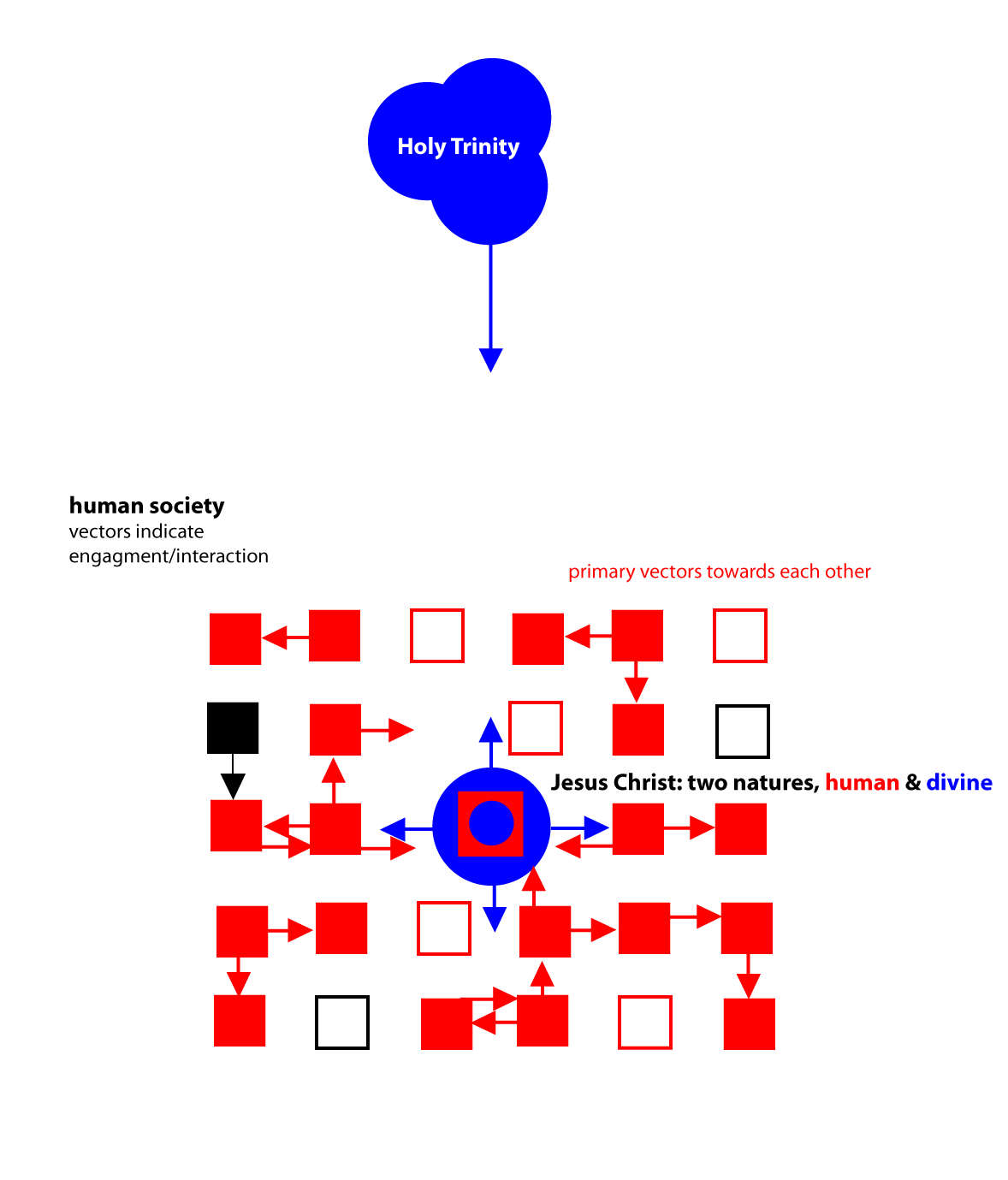
A typical human society consists of individuals with [relatively] normal psyche – i.e. capable of empathy and genuine engagement with the others (red squares). Any society always has some individuals with pathologies who for some reason are unable to empathize or to relate to others in a genuine way (black squares). Obviously, the more devoid of empathy/pathological individuals that are present, the less healthy is the society.

Pic 1. The earthly ministry of Jesus Christ


The above is what Jesus Christ had to deal with while walking in Galilee and preaching. His words and He Himself could be accepted or rejected by the others but he was never ignored, “not seen” or “walled off by silence” (this is something that happened to Him much later, close to Golgotha). 

Saturday, 4 May 2019

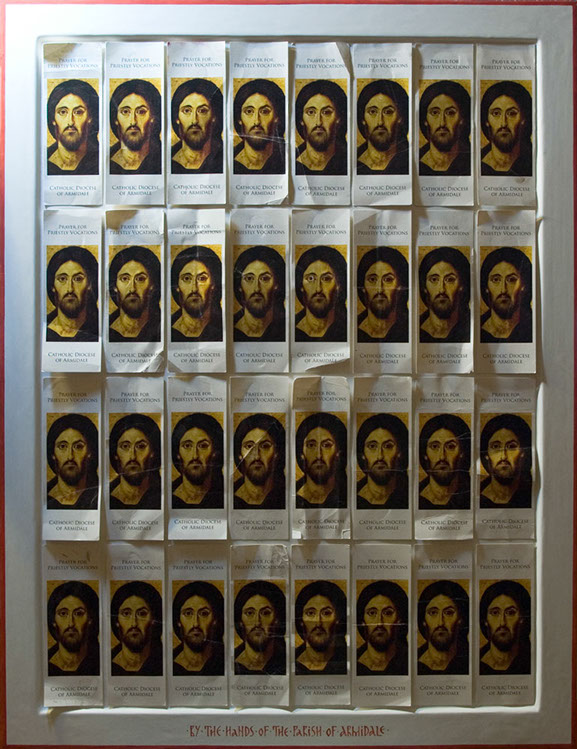
By the Hands of the Parish of Armidale


2019, prayer cards & egg tempera on board, 97 x 74 cm

This work makes use of the prayer cards distributed in the Roman Catholic Cathedral of Armidale, NSW for the purpose of praying for priestly vocations.om Sinai, the earliest (6th c.) and arguably the most famous icon of Jesus Christ.

The damaged prayer cards have been collected from the pews and used as they were found. No additional damage has been done.

“By the hand of…” is a customary expression used by an iconographer when they sign their work (on the reverse side of an icon). It highlights the fact that it is not she who made an icon but the Holy Spirit, she = her hand = was only the tool.

Thursday, 13 December 2018

Friday, 11 May 2018

Сердце Нового Завета

Любовь, данная опосредованно

“Вся вечность не так ценна, как тот день, в который “Песня Песней” была дана Израилю; все книги Писания святы, но Песня Песней – это Святая Святых” (Рабби Акива, 1-2 вв. н.э.)

Как это часто подчеркивается иудейскими и христианскими авторами, “Песня Песней” не похожа ни на одну книгу Ветхого Завета. Она не описывает извилистую историю человечества как “Бытие”. Она не провозглашает заповеди Бога, согласно которым Израиль должен жить, если он хочет оставаться избранным народом Божиим, как “Исход”. Она не выражает огромные боль и гнев Бога, Который вновь и вновь предается Своим народом, как книги пророков. Это правда, что некоторые пророки описывали взаимотношения Бога с Израилем в терминах брачной любви. В то время как эти термины были не просто метафорами, но указывали на метафизическую реальность, на природу любви Бога к человечеству (которая наиболее адекватно может быть описана в терминах супружеской любви), внимание пророков было сосредоточено на развертывании событий в конкретное время истории Израиля и в грядущие времена (приход Мессии). Аллюзии к божественному Супругу и неверной жене, даже блуднице, служили подобающим описанием поведения Израиля по отношению к Богу. Говоря о временах, совершенно очевидно, что книги пророков актуальны и в наше время и будут актуальны до конца времен, потому что они показывают человеческое отношение к Богу, которое, подобно идущей вниз спирали, повторяется в разные времена и так и будет повторяться – до тех пор, пока времени больше не будет. “Песня Песней”, как мне кажется, принадлежит к этой “нет-больше-времени” категории. Это есть сейчас и будет всегда, вне времени = без времени, как и любая встреча души с Богом, в любви; или двух людей в любви; или же, обобщенно говоря, двух личностей в любви.

“Песня Песней” – это олицетворение предельной кристалльной простоты. В ней нет абсолютно ничего, кроме любви двоих, непреодолимо влекомых друг к другу. Природа любви Бога к Израилю (иудаистическая интерпретация)/любовь Бога к человеческой душе и этой души – к Богу (христианская интерпретация) описана здесь на языке двух влюбленных, опьяненных взаимыми откликами. Бог открывает Себя самым простым из всех возможных методом;  его откровение о Самом Себе – это откровение о Своей сущности, Любви (Бог есть Любовь), любовно действующей на человеческую душу, которая в свою очередь, будучи созданной по образу и подобию Бога (Который есть Любовь), способна ответить Ему любовью, данной Им ей изначально. Я пытаюсь выразить, что самая сущность Бога, т.е. нечто, мысль о чем заставляет верущего содрогаться от осознания собственной малости, может быть описана посредством вполне человеческой любви-эроса, известной аблолютно всем. И не только описана, но и узнана на опыте.

Wednesday, 9 May 2018

The heart of the New Testament


Love referred

“For all of eternity in its entirety is not as worthy as the day on which Song of Songs was given to Israel, for all the Writings are holy, but Song of Songs is the Holy of Holies.” (Rabbi Akiva, 1-2 c. AD)

As it is often stated by both Jewish and Christian authors ‘Song of Songs’ is unlike any other book in the Old Testament. It does not relate the convoluted history of humanity like Genesis. It does not proclaim the rules which God wishes His people to follow if they want to remain His chosen possession like Exodus. It does not vent the enormous hurt and anger of God Who is betrayed by His people again and again like books of Prophets. It is true that several prophets described the relationship of God with Israel in spousal terms. While those terms were not a mere metaphor but hinted the metaphysical reality, the nature of love of God for humanity (which can be the most adequately described in terms of the spousal love), the focus of the prophets were the unfolding events in a particular time of history of Israel and in the future time (the coming of the Messiah). The references to the jealous divine Spouse and the unfaithful bride, even whore, where serving as an apt description of the Israel’s conduct towards God. Speaking about times, the prophet’s books are obviously relevant to our time and till the end of times because they convey the human attitude to God that, like a downfall spiral, repeats in times and will repeat itself until the time will be no more. ‘Song of Songs’, it seems to me, belongs to that “no more time” category. It is now and it will always be, out of time = timeless, as any encounter of a soul with God, in love. Or two humans in love. Or, to include both, it is two persons in love.

‘Song of Songs’ is the epitome of simplicity. There is absolutely nothing there but love between the two irresistibly drawn towards each other. The nature of love of God for Israel (Judaic interpretation)/love of God for a human soul and of this soul– for God (Christian interpretation) is described in the language of two lovers intoxicated by each other’s response. Meaning, God reveals himself in the simplest possible way here i.e. his self-revelation is about his own essence (God is Love) acting in love towards a human soul which is, being an image of God (Who is Love) is capable of answering Him with that love which He gave her in advance. What I am trying to say here is that the very essence of God i.e. something truly unthinkable, something the thought of which makes a believer tremble and shrink in realisation of own smallness, can be conveyed by the very human erotic love known to anyone. And not just conveyed but experienced as well.

Wednesday, 14 June 2017

memo

"I knew perfectly well that I had a soul, but I did not understand what that soul merited, or Who dwelt within it, until I closed my eyes to the vanities of this world in order to see it. I think, if I had understood then, as I do now, how this great King really dwells within this little palace of my soul, I should not have left Him alone so often, but should have stayed with Him and never have allowed His dwelling-place to get so dirty."
'The Way of Perfection', St Teresa of Avila


Saturday, 10 June 2017

Антиприст

Не со-общающийся Христос

Верная передача значения английского слова “to relate” (“The non-relating Christ”), использованного в английском оригинале эссе, крайне важна для понимания всего текста. “Общаться” – слишком активное действие, “относиться” – слишком пассивное, и оба слова “не совсем то”, поэтому я остановилась на почти вышедшем из употребления значении слова “сообщающийся” в применении к людям, а не только к сосудам. Я нарочно пишу его как “со-общающийся”, чтобы подчеркнуть разницу, т.е. одушевленность действия.
Под выражением “со-общающийся Христос” подразумевается Христос, лично относящийся к верующему, Христос “на связи”, с Которым можно найти контакт, Который желает такого контакта, Который отвечает и обращается, одним словом, тот, с кем возможна взаимная связь/личные отношения в многообразных формах, знакомых верующим по опыту.
Проще дать аналогию: человек с нормальной психикой.

Представьте себе, как бы это выглядело. Христос воплотился бы, вырос и начал обходить крошечные городки Иудеи, чудесным образом исцеляя больных, изгоняя бесов, говоря толпам, что “блаженны нищие духом” и “подставьте другую щеку”. Он бы делал все это “в общем”, как некто с миссией донести определенные слова до слушателей. Об бы делал все, что описано в Евангелиях, но при этом никак не со-общаясь с людьми. Нет, Он не хранил  бы молчание, когда апостолы разбудили Его, испугавшись, что их лодку вот-вот перевернет бурей – Он бы просто произнес “волны, утихните” а затем, не добавив “почему вы так маловерны?”, обращенное к апостолам, вернулся бы к своему тюфяку.

Или же Он мог произнести эти слова, но очень безличностно, без какой-либо реальной эмоциональной связи со Своими учениками, сердце к сердцу. Можно ведь сказать “я люблю тебя” так, что тот, к кому эти слова обращены, почувствует, что его словно пронзили ножом, столь очевидна их ложь. Он мог бы также войти в Иерусалим предельно безличностно, без каких бы то ни было личных ремарк и, точно в такой же безличностной манере, мог бы быть распятым и умереть. Он мог бы молиться за тех, кто Его распял, но делать это пусто и безлично, просто потому, что Сын Человеческий должен сказать эти слова. Это вписывалось в Его учение. Xристанин должен молиться о своих врагах, вот Он и подал нам пример – может быть, он произнес эти слова именно по этой причине. Он мог бы сказать их про себя; в конце концов, Его Отец все равно бы Его услышал.

Friday, 5 May 2017

...

One year in Carmel