Showing posts with label politics. Show all posts

Thursday, 23 June 2016

The Conductor

The Holy and Great Orthodox Council

Consider the collage:

- [video] Patriarch Kirill meeting Pope Francis – [photo] Patriarch Kirill with penguins - [photo] Patriarch Kirill with the Catholic bishops in Latin America – [opinions] Patriarch Kirill betrayed Orthodoxy – [video] President Putin standing in the stacidia, the supposed Byzantine throne, in the major monastery on Athos – [opinions] “Putin was enthroned as the new emperor - [articles] Patriarch Kirill refuses to go to the Holy and Great Council of the Orthodox Church - [opinions] Patriarch Kirill is the defender of Orthodoxy against the heresy of ecumenism -
This is a sample of what is being poured out of the Russian mass-media into the world on a daily basis over the time period preceding the Holy and Great Council of the Orthodox Church.

Currently the mass-media in Russia and abroad are proposing, as usual, various more or less logical explanations of the behaviour of the Patriarch of the ROC MP who refused to come to the Great Orthodox Council. They say that:

- Patriarch Kirill went too far with the Pope and hence was pressed, by the Russian Orthodox fundamentalists, “to pull back” and not to go to the Council organized by the crypto-Catholic and NATO puppet, the Ecumenical Patriarch of Constantinople - Patriarch Kirill is blackmailing Constantinople re his recognising the Ukrainian Orthodox Church - Patriarch Kirill is nothing and simply does what Kremlin tells him - Patriarch Kirill only pretended to be crypto-Catholic, fooled the Ecumenical Patriarch so now everyone “sees it all” [what all is not clarified] – and then refused to go to Council - Patriarch Kirill, together with President Putin, simply needs the very murkiness of Orthodoxy and the Council, by its very purpose to clarify at least something in the Orthodox Church, threatens that murkiness, indispensable for the Russian’s murky deeds, in the Orthodox Church and in the secular world -

The problems with those versions are that all of them, apart from the last one, do not withstand the news about yet another astounding move of “the tandem” (Putin-Kirill) which blows off all the previous attempts to attribute to them at least some logic and propose some predictability. And even the latest version does not withstand a close examination: how would the “murkiness” needed by the ROC MP be threatened by the proposed extremely mild relaxation of the fasting rules for example? Another pre-conciliar document which caused most arguments, ‘Relations of the Orthodox Church with the Rest of the Christian world’ also could not reduce the murkiness because, if the Council accepted “the most scandalous proposition”, to call the Catholic and other Churches “churches”, it would cause plenty of stirring and murkiness in the ROC MP, especially if such a stirring was aided. One may argue that it is always possible to add the murkiness, stirring Orthodox fundamentalists and liberals, clashing them and so on: the recent waves of the Orthodox fundamentalist uprising in Russia demonstrated it quite well. One must be very naïve to think that the ROC MP [read: Kremlin] has no means to shut up those whom they want to shut up and to encourage those whose voices they find profitable for the moment. Hence, there is only one real insight in this version, namely the statement that the ROC MP and Kremlin need murkiness to work effectively. But this has been well-established long ago, by the various analysts of the principals of “hybrid war”.

The murkiness or chaos does not work well in/by itself though. If we consider the map of moves by our tandem, Putin and Kirill, and look at the naked facts, we will see that both President Putin and Patriarch Kirill have met with the Pope. In fact, Putin has done it several times. Both President Putin and Patriarch Kirill went to Athos recently, together. However, everyone spoke about Putin on Athos, very few about – “Putin and Patriarch Kirill on Athos”, and no one about – “Patriarch Kirill on Athos”.  Just the same, hardly anyone in Orthodox circles spoke of Putin meeting Pope Francis as much as about Patriarch Kirill meeting Pope Francis.


The principles of composing

Relatively recently, analysing the work of David Bowie, I proposed that his songs are built up from a highly detailed chaotic library of various symbols, metaphors and messages (as a rule, mutually contradictory) and also of quite random, “simple and straightforward”, statements which work as “camouflage of seeming simplicity” for the major, more sophisticated, messages. Typically, his songs consist of several “sub-songs” in them; each of them was cut and then reassembled in a new way, fogging and hiding what originally [if one can identify that original] was quite clear.


Thursday, 23 April 2015

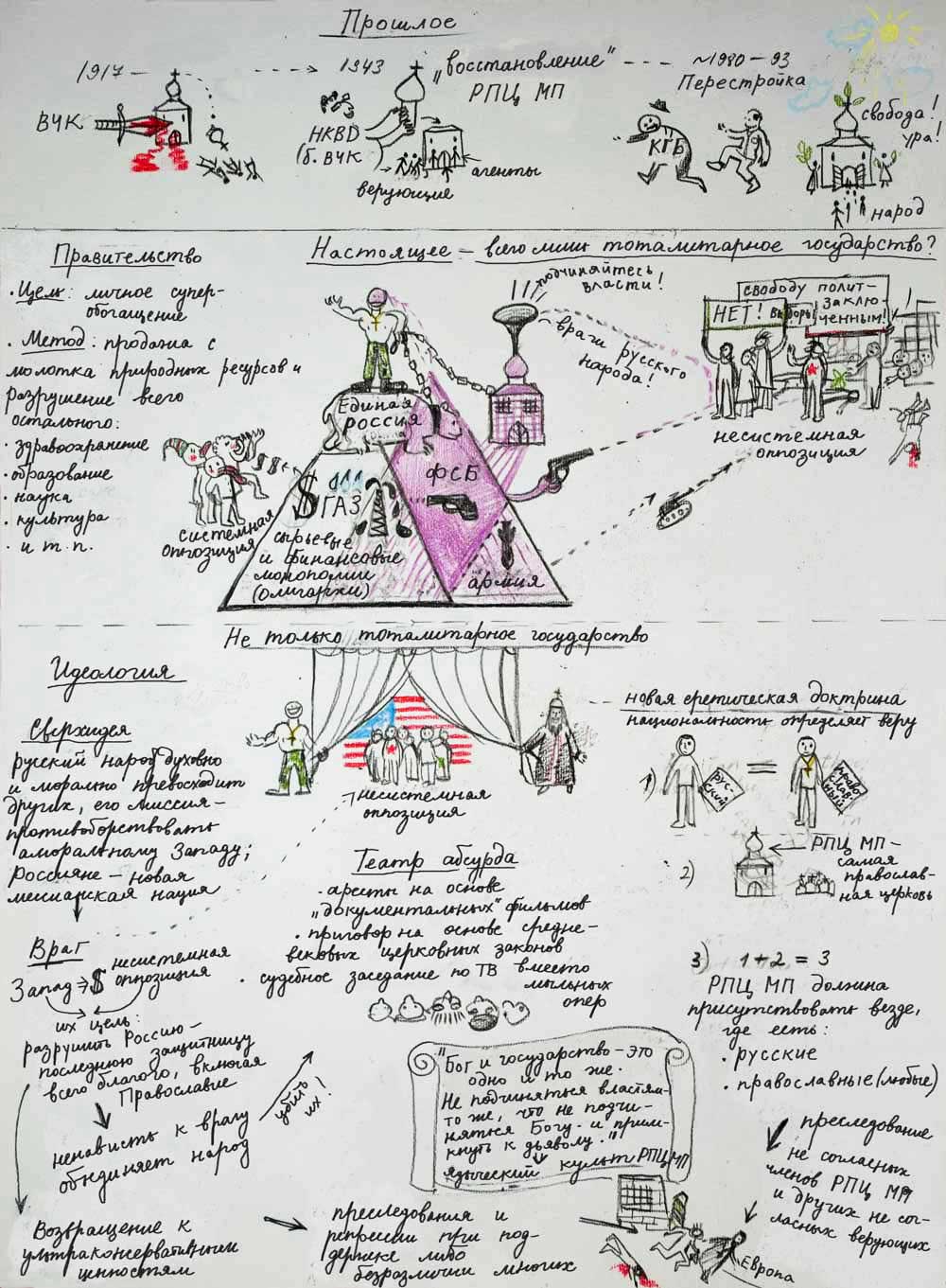
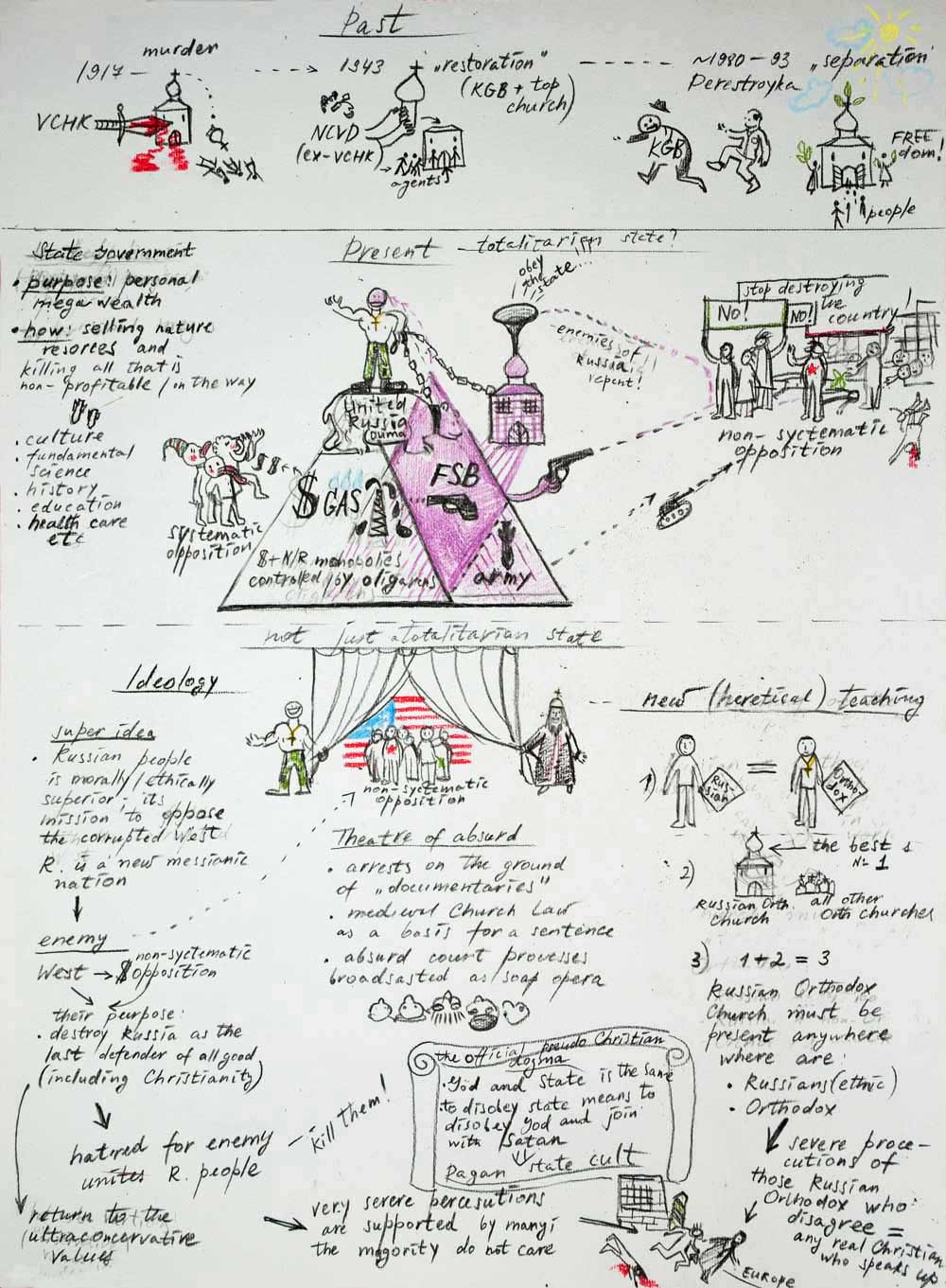
Молитва перед российской пропагандой

Господь мой Иисус Христос, дай мне сил выдержать слушание/ чтение/ просмотр российской пропаганды! Даруй мне рассуждение, чтобы отличить правду от неправды, а что я не могу понять, сделай так, чтобы я забыл все это. И избавь меня от всех незаметных мне последствий пропаганды, дабы семена мерзости, обманом войдя в мою душу, не укоренились бы в ней. Защити мое сердце от растерянности, бесконечных сомнений в самом себе, паралича воли, страха, отчаяния, цинизма, ненависти и неверия. Избавь меня от морока лжи и пленения ею моей души. Молю тебя, Боже, очисти меня и сохрани меня для Себя. Аминь.
--------------------------------------------------------

Антирелигиозная пропаганда не была изобретена в Советском Союзе. До нас дошла древнеримская карикатура на Распятие, изображающая Христа в виде осла. Римская карикатура прямолинейна. Осел или человек с ослиной головой на ней – это всего лишь осел, животное, не нагруженное чередой противоречивых смыслов. “Христос – идиот, если он дал себя распять; христиане – идиоты, если они поклоняются Распятому”, вот и весь нехитрый смысл примитивной насмешки. Быть христианином – значит быть ослом, идиотом. В случае, однако, если на кресте появляется реальный или придуманный персонаж с историей (Микки Маус, Гагарин), ситуация кардинально меняется. Введение в устоявшуюся иконографию Распятия нового персонажа со своей собственной историей/ замена им Христа создает пространство для гораздо более утонченных насмешек. По моему мнению, главными отличительными особенностями этого нового, постмодернистского, типа карикатур, является 1) наличие множественных взаимоисключающих смыслов (среди которых непременно есть “как бы благой”) 2) стремление сделать зрителя соавтором и “продолжателем” темы карикатуры, незаметно для него самого. Показать на примерах, в чем отличие постмодернистской российской пропаганды от более привычной прямолинейной “римской”/советской и как именно она работает с умами – цель этой статьи.

Thursday, 26 March 2015

Putin's information war in the Australian bush


Driving through the Australian bush I was surprised to come upon an outpost of the Russian Government. I could not bypass this without taking a photo.

1) the original and 2) restoration with truth


see the panoramic view inside

Sunday, 22 March 2015

Относительно убийства Немцова

Я пыталась думать и писать об убийстве Немцова с того самого дня двадцать седьмого февраля, когда оно произошло, но из этого ничего не получалось. Написанные параграфы разваливались, словно куличики из песка: по отдельности они имели смысл но, объединеныe с другими, они его утрачивали. Теперь я ощущаю силу, почти что заставляющую меня написать об этом. До этого были только фрагменты событий и версий, предлагаемые многочисленными обозревателями и аналитиками. Они только затемняли то, что было там с самого начала, пока еще невидимое. Теперь я знаю, что это было. Ниже – голые факты, а затем – мое понимание их.

Regarding the murder of Nemtsov

I have been trying to think and write about Nemtsov’s murder since it happened on 27th of February but somehow I could not. I would write a few paragraphs but they would fall apart like sand cakes; they worked by themselves but they did not make a coherent meaning as a whole. Now I feel the force to write. Before there were just the fragments of the events and their versions, offered by the multitude of observers and analysts. They only obscured that, that was there yet unseen. Now I think I know what was that that. So here are the naked facts and then my understanding.

Saturday, 21 February 2015

Athos for Putin


“Greek clergy and public figures are going to present a gift to Russian President Vladimir Putin a unique icon - Patriotissa Panagia (Virgin of patriot), or "Unity". It was written specifically for Russia, in gratitude for their contribution to preserving the traditions of Orthodoxy, for his contribution to the development of Europe, told Russian journalists clergy and representatives of the NGO ELAIA ("Elia", "Oliva").
Present the icon as a gift planned in 2016 year, when the cross year Russia and Greece.
Icon painters of Mount Athos wrote, it is unique not only for work but also in size - 2,3 1,8 meters per meter. Weighs icon 150 kilograms. And it is called "Unity", because it is a line from the Gospel - "Let there be one."
At the writing of icons blessed Patriarch of Moscow and All Russia Kirill, said rector of the church of Panagia Sumela in Minidi Father Gregory. In his temple to be stored icon until it is transported to Russia.”
[The full text of the article released English is provided in the Appendix below.]

This news item first appeared on the 16th of February on Russian news websites.  The English text above appears on the website ‘News CYPRUS’ and is reproduced exactly.
Before going any further I must clarify that the title (or name) of the icon which was, for some reason, mistranslated into English as “Virgin of patriot”. The word “patriot” is indeed written on the right side of the halo of the Mother of God, immediately below the customary Greek four-letters abbreviation “MP OY” – “Mother of God”; this is the title of the icon. However, the word in question is written in Russian and says “ПAT-PИO-TKA” (“patriot-ka”) that is a single female form of the word “patriot” – “female patriot”. Properly translated, the title of the icon is “Mother of God the Patriot” and this is in fact how it has been translated in Russian mass-media. It is noteworthy that in Russia we have many kinds of icon of the Mother God like “Mother of God the Milk Giver”, “Mother of God the Hope of those who have lost hope”, etc. We have never had “Mother of God the Patriot” though.

Friday, 20 February 2015

Афон для Путина

"Греческие священнослужители и общественные деятели намерены преподнести в дар президенту России Владимиру Путину уникальную икону — Панайа Патриотисса (Божья матерь Патриотка), или "Единство". Ее написали специально для России в благодарность за вклад в сохранение традиций православия, за вклад в развитие Европы, рассказали российским журналистам священнослужители и представители общественной организации ELAIA.
Икону писали иконописцы на Афоне, она является уникальной не только по работе, но и по размеру — 2,3 метра на 1,8 метра. Весит икона 150 килограммов. Ее называют и "Единство", поскольку на ней есть строка из Евангелия — "Да будет едино".
На написание иконы благословил Патриарх Кирилл (Гундяев), сообщил настоятель церкви Панайа Сумела в Миниди отец Григорий. В его храме будет храниться икона, пока ее не перевезут в Россию."
[полный текст статьи дан в приложении ниже]. 


Несколько лет назад этот текст воспринимался бы как пародия или бред. Сегодня в нем мало что вызывает сильные эмоции. Эта усталость души, как мне кажется, доказывает верность ощущения, что в своем неумолимом стремлении к абсолютому злу Россия одерживает победу. Уже мало что удивляет, т.к. восприятие притупилось от изобилия абсурда и лжи. То, что эта новость из Греции, а не из России, ничего не меняет: Греция приобщилась российской заразы и стала частью России на метафизической карте.

Предоставляя читателю самому составить мнение о содержащихся в тексте заявлениях, я сразу перейду к главному – к самой иконе, а еще точнее – к ее иконографической схеме, дающей ключ к ее пониманию. 

Tuesday, 9 September 2014

Путин без зеркал

Загадка мистера Путина


В настоящее время президент Российской Федерации В.В. Путин купается в свете прожекторов, ярких, как никогда. "Мачо", "супермен", "самый вежливый человек" (вставьте любое любое клише) продолжает оставаться для Запада загадкой. И, судя по реакциям и действиям подавляющего большинства западных политиков, они продолжают не видеть, с кем они имеют дело.

Существует несколько причин этой странной слепоты, в том числе вполне сознательные и рациональные, например
, получаемые их странами временные выгоды, пока они остаются слепыми и глухими. Тем не менее, даже если вообразить гипотетическую ситуацию, в которой политики разом отказываются от временных выгод и концентрируются на глобальной и вполне реальной проблеме Третьей Мировой Войны, начатой в Украине, они бы все равно не знали, что им делать с "мистером Путиным". И это совсем не удивительно, т.к. они воспринимают его как другого человека.

Putin without mirrors

The enigma of Mr. Putin

Currently the president of the Russian Federation, Mr. Putin, is more in the spotlight than ever. “The super tough guy”, “the Russian macho” – whatever the cliché – is as “enigmatic” to the West as ever. Judging by the actions of the overwhelming majority of world politicians they are still unable to understand with whom they are dealing. 


There are multiple reasons for that perceived blind spot of course including rational and conscious reasons, for instance the temporary benefits their countries may reap while they remain ‘blind’. Still, even if one imagines the hypothetical situation when the political leaders of the whole world suddenly became free from those temporary concerns and concentrated on the very real and big issue of the Third World War starting in Ukraine they still would not know how to deal with Mr. Putin. This is not at all surprising because they think of him as another person. 

Thursday, 28 August 2014

Хроники деконструкции смыслов

"Если подумать, Адольф Гитлер был первой поп-звездой."
(Дэвид Боуи)


Предисловие: о телемикроскопе

Год назад в статье “Утрата веры” я сочла необходимым написать о РПЦ МП следующее:
“… [вы] уподобляетесь окрашенным гробам, которые снаружи кажутся красивыми, а внутри полны костей мертвых и всякой нечистоты; так и вы, по наружности кажетесь людям праведными, а внутри исполнены лицемерия и беззакония.”[1]
… Вся глобальная и многоуровневая ложь РПЦ вдруг разом сложилась в одну картину. Вот Патриарх Кирилл лжет о Церкви, произнося пустые, фальшиво звучащие проповеди, лжет потому, что он не верит в Бога, а безбожник, сколько он не пытается сказать что-нибудь о Церкви и о Боге, не в состоянии выдавить из себя ничего, кроме фальшивки. Вот архиепископы и епископы, тоже не верующие, поднимаюшие Чаши за Евхаристией, а хор поет "Тело Христово приимите". А вот другие, истово верующие, вначале в могущество России, и лишь потом – в Христа, причем урезанного Христа, который подходит к их главной вере в империю. Впрочем, Христос вспоминается ими редко. Их паства, которая верит, что главное – правильное исполнение ритуалов, свечки в храмах, национально-православная атрибутика, не знает о Христе, Его апостолах, христианах первых столетий вообще ни-че-го. Весь этот ужас прекрасно вписывался в современную идеологию РПЦ, которая уже давно перстала быть православной и христианской, а стала "русской церковью", отправителем этнического и государственного культа. Ложь, среди которой, каким-то чудом еще происходит таинство Евхаристии.”


Эта статья была ответом на убийство о. Павла Адельгейма, последнего широкоизвестного священника РПЦ МП из тех, кто бескомпромиссно следовал за Христом и не боялся говорить правду. Его убийство вызвало
шок и скорбь в России и почти ничего – в мире, даже в православных кругах. Это неудивительно: христиан убивают ежедневно, во всем мире. Убийства (христиан и не христиан без различия) – это безусловное зло, и я не могу сказать, что убийство о. Павла было “особенным злом”. Тем не менее, в моем восприятии оно стоит особняком из-за своего густого и тяжкого символизма, символизма метафизического масштаба, который делает его событием, имеющим отношение  не только к российским православным или гражданам РФ, но и ко всем людям. Для меня случившееся стало символическим актом абсолютного зла, которое в наши дни решило актуализировать себя в России. Зло выплюнуло одного из тех, кто ясно видел его приближение и сказал “нет”. Говоря более понятным для современного западного человека языком, последний белый рыцарь был убит драконом; королевство, наконец, захвачено и ворота открыты настежь; теперь ничто не сможет помешать зверю бросить свою армию в мир.

Мне любопытно, почему голливудские фильмы о плохих и хороших парнях, плохих и хороших ведьмах, плохих и хороших духах пользуются неизменной популярностью на “прагматичном, циничном Западе”. Почему сказка о каких-то хоббитах, несущих за тридевять земель некое дявольское кольцо ради того, чтобы бросить его в адский огонь, чтобы наконец восторжествовало абсолютное добро, воспринимается взрослыми людьми с энтузиазмом, вплоть до готовности играть роли из фильма и даже носить “единственное кольцо” (в специально отведенное для этого время), не боясь выглядеть при этом смешными,
a христианин, осмелившийся заговорить о князе тьмы или падших ангелах, выглядит смешным в глазах многих. На мой взгляд, это похоже на упорный отказ всмотреться на реальность и увидеть упорную хроническую неспособность мира стать хорошим, несмотря на все наши усилия сделать его таковым или, говоря радикальным языком Евенгелия, признать, что “весь мир лежит во зле”[2]. Это просто-таки показательный случай из психологии К. Юнга: бессознательное ощущение присутствия абсолютного зла в мире переносится в безопасный формат ролевых игр в хороших и плохих ребят. Поэтому я делаю вывод, что над христианином, рассуждающим о зле, смеются потому, что он напоминает сознанию собеседника о том, что тот вытеснил и затолкал в самые темные и дальние углы своей души. Говоря о зле, христианин чудовищно серьезен; хуже того, он предпочитает называть его не просто “мировое зло” или “темные силы”, но “сатана” или “демон”, таким образом настаивая на том, что зло – это не абстракция, но что оно имеет реальность личности. Подобная ясность языка – это не только раздражающая особенность христианского мышления, но и очень важный его аспект. Я убеждена в том, что аллергия на ясность языка, особенно когда речь идет о "трудных" предметах, таких, как экзистенциональные и метафизические вопросы, является одним из важнейших составляющих в разворачивающейся перед нами и балансирующей на грани третьей мировой войны игре.

Tuesday, 26 August 2014

Chronicles of the deconstruction of meaning

"When you think about it, Adolph Hitler was the first pop star."
(David Bowie)


Preface: about a telemicroscope

A year ago in the article ‘The Loss of Faith’ I was compelled to write concerning the Moscow Patriarchate of the Russian Orthodox Church quoting from the gospel of Matthew:
“…. you are like whitewashed tombs which indeed appear beautiful outwardly, but inside are full of dead men’s bones and all uncleanness.… you also outwardly appear righteous to men, but inside you are full of hypocrisy and lawlessness.”[1]

At that time all the global and multilayered lies of the ROC MP[2] had suddenly assembled into a one coherent picture. Here was Patriarch Cyril uttering lies, delivering empty, false sermons – lying because he does not believe in God and a godless person is unable to squeeze out of himself anything but falsity about God even if tries hard. Here were non-believing Godless priests and bishops raising Eucharistic Cups while choirs sing “Receive the Body of Christ”. And here are followers ardently believing, first in the mighty power of Russia and only after that in a reduced version of Christ which fits their primary faith in the empire. The name of Christ is mentioned by them rarely now. Their congregations seam to believe that the most important thing is the correct conduct of the rituals: candles in the churches, national-Orthodox attributes while knowing almost nothing about Christ, His apostles, Christians of the first centuries. This horror fits well the contemporary ideology of the ROC MP which long ago ceased to be Orthodox and Christian but became instead “the Russian church”, the conductor of the state cult. A lie amongst which, by some miracle, the Sacrament of the Eucharist is still happening.

That article was a response to the murder of Fr Pavel Adelgeim, the last publicly visible priest of the ROC MP who followed Christ without compromise and dared to speak the truth plainly. His murder made a big impact in Russia and almost zero – around the world, even in the Orthodox Churches. It is not surprising; Christians are murdered every day around the globe. Murders (of Christians and non-Christians alike) are evil and I cannot say that the murder of Fr Pavel was “particularly evil”. Nevertheless, in my mind it stands out because of its gross symbolism, the symbolism of a grand metaphysical scale that makes the event relevant not just to the Russian Orthodox or Russian citizen but to all people. To me it was no less then a symbolic action of the universal evil which now choses to actualize itself in Russia. The evil spat out one of those few who clearly saw it rising and opposed it. Speaking the more understandable to the Westerner language, the last white knight was slain by the dragon; the kingdom is overtaken at last and the gates are opened wide; now nothing can stop the beast from leading its army into the world.

I wonder why the Hollywood movies about good and bad guys, good and evil witches etc are ever popular even in “the pragmatic and materialistic Western society” (a Russian cliché). Why the story about some hobbits taking an evil ring back to the evil fire to overthrow the evil king for the sake of the triumph of the universal good are met with enthusiasm by the adults who are prepared to play the movie roles and even wear “the one ring” (during specially assigned times) not fearing to seen as “ridiculous” but when a Christian dares to speak about the prince of darkness and good or fallen angels he become ridiculous in the eyes of the majority. To me it looks like the adamant refusal “to get real” and recognize a chronic failure of this world, despite all human effort, to be good or, using the more radical language of the Gospels, to admit that “the whole world lies in the power of the evil one”[3]. It is such a Jungian case: an unconscious perception of the acting universal evil in the world is transferred into the safe frame of enacted games about good guys and bad guys. Hence I conclude that when a Christian speaks about the evil he is laughed at because he reminds the consciousness of the listener about that that was pushed far into the dark corners of the psyche. He is deadly serious about the evil; worse even, he often calls it not just “evil principal” or “dark force” but “Satan” or “demon” thus insisting that “the force” has the reality of the person. Such a clarity of definitions is not just annoying but crucial. I believe that the allergy for a clear language, especially when it deals with “difficult” matters like existential and metaphysical truth is one of the major factors in the current state, balancing-on-the-edge-of-the-third-world-war.


Wednesday, 24 July 2013

Reinventing fascism

Black priestly dress, golden epaulets
(…)
Patriarch Gundyav believes in Putin,
Better if he, bitch, believed in God
These lines of the song written by the punk-feminist group ‘Pussy Riot’ encapsulate the fascist turn of current Russian affairs. The West learnt about ‘Pussy Riot’ almost instantly after their first (and the last) performance of the song in the number one Russian Orthodox patriarchate cathedral in Moscow. Following the tradition of supporting social freedoms, a few months later a series of Western voices fervently protested against the two year prison sentence given to the three singers but (judging by the responses in Western mass-media) failed to recognize the significance of their performance which targeted the very core of Russian politics. “When we say “Lenin” – we mean “the Party” wrote Mayakovsky, now one may write “When we say “United Russia” (the ruling party) – we mean “the ROC” (Russian Orthodox Church). 

Saturday, 15 June 2013

Блаженны изгнанные за правду (Мф 5:10)

Христианство пытались уничтожить с самого его рождения. Спасителя распяли, из его ближайших учеников умер от старости только один апостол Иоанн. Апостол Иаков, брат Господень, за свою праведность почитался жителями Иерусалима святым – как иудеями, так и евреями-христианами. Когда новое абсурдное учение начало набирать силу, влиятельные иудеи и священники иерусалимского храма обратились к Иакову с просьбой сказать народу правду об Иисусе и тем самым развенчать суеверное почитание покойного богохульника. Иаков молча поднялся, как его просили, на крыло иерусалимского храма, на высоту, чтобы его слова были слышнее собравшемуся народу, а затем, после некоторой паузы (толпа ждала, затаив дыхание), громко произнес: "Что спрашиваете меня о Сыне Человеческом? Он восседает на небе одесную Великой Силы и приидет на облаках небесных"[1]. Услышав это, священники вначале остолбенели от неожиданности, а затем сбросили Иакова со стены храма на землю и там добили (Евсевий пишет страшно-обыденно "добили скалкой").


Tuesday, 26 February 2013

Православие и революция

1
На каждой церковной службе мы молимся: "да тихое и безмолвное житие проживем во всяком благочестии и чистоте". Понятое буквально, "тихое и безмолвное житие", особенно в сочетании с молитвой о властях, по определению лишает православного верующего возможности какого бы то ни было участия в революции. У многих слово "православный" ассоциируется с послушным священноначалию и светским властям человеком, не интересующимся политикой, проявляющим возмущение только, если "внешние" совершают нечто оскорбительное для его веры и только если есть благословение на возмущение и активные действия.
Тем не менее, слово "революция" не чуждо христианину. Христианство, прежде всего, ориентировано на внутреннего человека и внутреннюю революцию. Личная встреча с Христом всегда переворачивает нутро, разбивает старые представления о плохом и хорошем в себе и мире. Евангелие прямо говорит о смерти ветхого (т.е., старого) человека закона и воскресении в Иисусе Христе к новой, преображенной, жизни. Обращение к Христу – это кризис, в разы страшнее и кровопролитнее, чем любая революция, страшный кризис видения себя такими, какие мы есть. Выход из этого внезапно открывшегося откровения о собственной душе возможен только через изменение всего существа, через то, что на греческом называется "метанойя" – резкое изменение ума, образа мыслей и всей жизни, покаяние. Начавшись внезапно и резко, метанойя продолжается всю жизнь христианина. Но возможно ли подобное изменение всего существа человека без выплеска вовне, в окружающий его мир?