
Sunday, 16 April 2017

Wednesday, 12 April 2017
Tuesday, 7 February 2017
Monday, 30 January 2017
The Variable Heart
This was her heart till now; a milk weed seed
Anchored securely to a wisp of down.
It had a drifting desultory creed;
but love remained its verb, remained its noun.
Anchored securely to a wisp of down.
It had a drifting desultory creed;
but love remained its verb, remained its noun.
Think how the wind moved and tormented her
and cast her forth on rock, on arid clay,
how even the least gust prevented her
from any constancy save her dismay.
and cast her forth on rock, on arid clay,
how even the least gust prevented her
from any constancy save her dismay.
This is a garden: pray the wind may let
her down in that soil where her roots can move.
Ask God to hold her till her roots are set
safe in the windless moment of His love.
her down in that soil where her roots can move.
Ask God to hold her till her roots are set
safe in the windless moment of His love.
(Jessica Powers)
Thursday, 26 January 2017

Wednesday, 25 January 2017
Векторы и структуры
Симбиоз: вектор насилия
Зло (демон), в верхней линии фигур, вошло в линию поколений
через жестокое обращение с детьми и теперь использует его для самовоспроизведения.
Перекореженная модель отношений "мать - дочь" повторяется в
разнообразных формах, характеризующихся так наз. "enmeshment" (т.е.,
размыванием/отсутствием личных границ, отсутствием автономного развития
личности), наиболее тяжелым вариантом которого является "эмоциональный
инцест" - мать делает из дочери собственного родителя/эрзац-супруга. Мать
таким образом компенсирует недостаток любви собственной матери, превращая свою
дочь в мать. В результате, дочь теперь"вечнобеременна" собственной
матерью, которая "растет" внутри нее, выталкивая из центра
"Я" дочери. Обратите внимание на векторы: вектор демонической энергии
беспрепятственно устремляется вперед, в то время как векторы жизни (жизненной
энергии) каждой женщины направлены назад, к собственной матери. Образно говоря,
каждая женщина "питается будущим", т.е. ее жизнь происходит из еще
нерожденных детей.
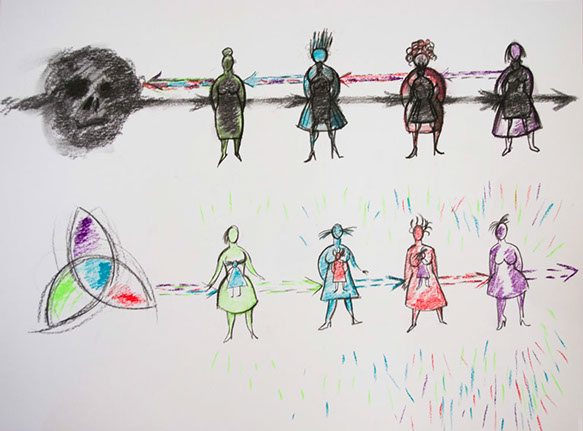
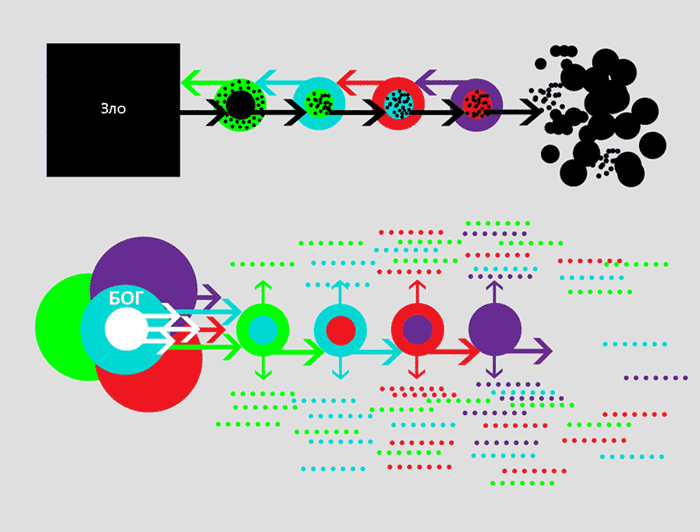
Нормальное положение вещей: каждая мать во второй линии фигур беременна собственной дочерью, которая, в свою очередь, продолжает линию поколений. Вектор жизни каждой, находясь в гармонии с вектором Бога, направлен вперед. Меньшие векторы расходятся во всех направлениях, обозначая развитие и плодотворность их жизней не только в сфере продолжения рода; фактически, им нет нужды "воспроизводиться ради выживания", как в верхней линии. Женщины черпают свою силу в Боге и в собственных матерях.
Monday, 23 January 2017
Vectors and structures [an investigation of the vectors of childhood abuse in relation to God]
Symbiosis: the vectors of abuse
The evil, in the upper line of figures, entered into a line
of generations via child abuse and now uses
it to reproduce itself. The twisted relationship “mother – daughter” keeps
repeating itself via various forms of abuse that involve enmeshment, the
extreme case of which is emotional incest i.e. a mother makes her daughter into
own parent/surrogate spouse. A mother compensates for the lack of her mother’s
love by making her daughter into her own mother. A daughter now is eternally
“pregnant” with own mother which is “growing” inside her, pushing the daughter’s
core = her Self aside from a centre. Note the vectors, of the evil going
onwards unobstructed, and of each woman’s life, directed backwards towards own
mother. Metaphorically speaking, each woman is “sucking the future” i.e. she derives
her life from the children to come.
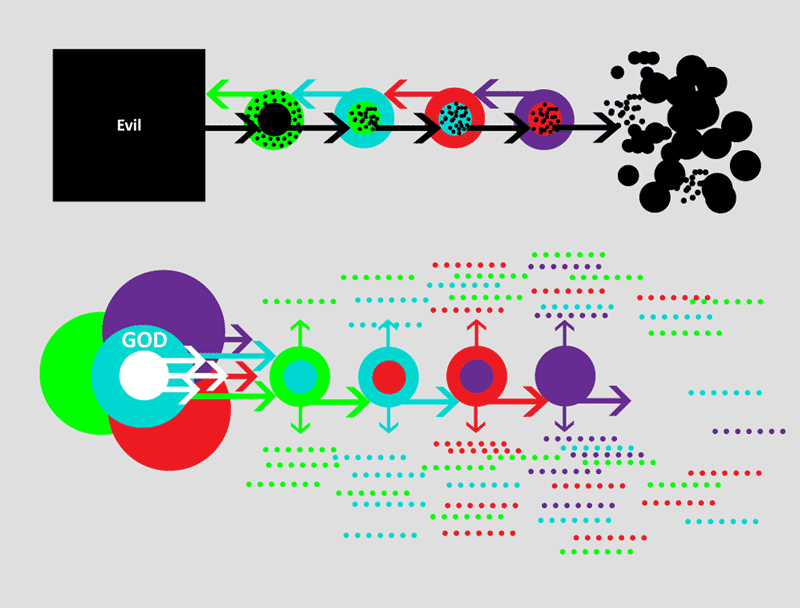
The normal order of things: each mother in the second line
of figures is pregnant with her own daughter who in turns continues the family
line. The vector of life for each, being in harmony with the vector of God, is
directed forwards. Smaller vectors are expanding in all directions indicating the
expansion of their life not just to a procreative realm but into the world; in
fact here there is no need to “procreate for survival” as in the line above. The
persons derive their strengths from God and their own mothers.
Friday, 23 December 2016


Wednesday, 14 December 2016
St John of the Cross

"No man of himself can succeed in voiding himself of all his desires in order to come to God."
Thursday, 27 October 2016
The Mass of TOB
My previous
paper on the current Theology of Body (TOB) movement (hereafter referred to as West-TOB,
after the name of its leading ideologist), ‘A pure gaze of lust’, was the
outcome of my attempts to understand why my encounter with it was so
destructive to my prayer life and especially to my relationship [or
attachment?] with Jesus Christ. I rationalized in the end of that paper that
the major reason for this was the West-TOB’s profanation of the most sacred, of
the love of God for a human soul, via muddling the sacred with what they call
“bold talk about sex”:
“I have been into Carmelite spirituality for some time now, with St John
of the Cross being my spiritual guide. Until I heard and read “the TO” my mind
was free from the obscene associations discussed above. It means that when I
read the lines of St John of the Cross from his ‘Spiritual Canticle: Songs
between the soul and the Bridegroom’:
“In the
inner wine cellar
I drank of my Beloved, and, when I went abroad through all this valley, I no longer knew anything, and lost the herd that I was following.”
I drank of my Beloved, and, when I went abroad through all this valley, I no longer knew anything, and lost the herd that I was following.”
Wednesday, 5 October 2016

Wednesday, 14 September 2016
Tuesday, 13 September 2016
A pure gaze of lust (some thoughts re: TOB and Christopher West, a letter to a friend)
Dear
***,
Thank
you for lending us the recommended by Fr *** books
‘Theology of the Body Made Simple’ by Anthony Percy and
‘Theology of the Body for Beginners’ by Christopher
West. I was somewhat surprised with the content of those
four public lectures which were announced, as you know,
as “Pope John Paul II’s Theology of the Body”. I have
sampled the lectures of Pope JP II in the past; I cannot
say I was wildly interested in the topic but
nevertheless interested enough to attend the local
lectures about TOB, probably out of my habit to attend
just anything in our parish that promises some theology,
especially if it is something new to me.
The
local lectures, while they clarified nothing about the
complex ideas of the Pope (as I recalled them), seemed
to also introduce something else that I found to be
sufficiently at odds with what I remembered from my
cursory reading of the ‘The Redemption of the Body and
the Sacramentality of Marriage’, the title of the of
Pope JP II’s Wednesday Catecheses. Hence I dived into
Pope John Paul II’s work again.
Almost
everyone comments that his text is extremely difficult
to get through. My difficulties with it are that the
topic is very wast and the ideas are very many; it is
exceedingly difficult to keep them all in mind while
moving through the dense text which is his separate
lectures presented in chronological order. Some say
there are many contradictions in the text as well; I
pinned a few. There is nothing surprising about that
though, considering that Pope JP II had given his
lectures over six years; it is only natural that his
thoughts would develop over that time, sometimes
abruptly I suspect. At least this is my impression.
Hence his talks appear to be anything but the smooth
monolith the modern TOB presents.
I think
I am almost instinctively drawing the line here, between
the ‘The Redemption of the Body and the Sacramentality
of Marriage’ and the current TOB movement, via
stressing the original title and the character of Pope
JP II’s lectures because the character of what is now
circulating in the Catholic Church makes it hard to see
it as the organic continuation of the Pope’s teaching
(please note that when I say “TOB” I always mean the
current TOB movement). While Pope John Paul II
indeed spoke much about the human body he would always
speak of it in the context of the human person. This is,
I believe, the #1 important difference between Pope JP
II’s thought and the thoughts of the developers of the
Theology of the Body (hence referred to as TOB) who tend
to consider the body as a separate entity. The body in
their take, being separated from the soul, becomes
somewhat impersonal. Consequentially, a human being can
now be considered as an animal whose bodily functions,
sexual in particular, can be observed, studied, and
discussed without the slightest consideration of the
dignity of his person. Hence comes the #2 important
difference between Pope JP II and the TOB-developers,
namely that the former, while discussing human
sexuality, does it far more broadly, laconically and
immeasurably more modestly than the latter.
Hence,
in my mind, there is a definite shift of the foci,
proportions and vectors which one can clearly
observe when comparing the teaching of Pope JP II and
the TOB being put side by side. At the same time, the
TOB seems to faithfully retain what they call “the
ground-breaking approach” of Pope JP II, four original
experiences of the human being, Original Solitude,
Original Unity, Original Nakedness and Original
Sin and following from them the realisations that
the human body is symbolic, nuptial, free and
fallen. It instructive though what the TOB does with
it:
“John Paul II is taking us
back to our proper roots. It is only from a proper
foundation that you can build anything of worth. To go
back to “the beginning” – to Original Solitude, Unity
and Nakedness – means to understand that only by opening
ourselves up to God, his creation and other human beings
can we mature.”[1]
I am
quite sure that, even while Pope JP II maintained the
utmost importance of the understanding of these
“original experiences” for his teaching about marriage,
he would not put it in the way that TOB does, i.e.
creating an impression that we must somehow run back to
Eden – he is a far better theologian than this. The
quote above creates a very strong vector “from the New
Testament to the Old”, “from the New Adam to the Old”,
“from being born in Christ – back to before the
Incarnation”. This is just an example of how the
handling of the Pope’s work can change its meaning via
blowing up some of its parts and reducing other,
distorting the proportions.
Before I
move on to the discussion of what actually propelled me
to write this letter I must say that I have numerous
disagreements with the thesis of Pope John Paul II. My
major disagreement is that I do not see any need in
creating some additional “logical concepts” (like “the
original experiences”) for backing up the Church’s
teaching about marriage (as it was delivered by ‘Humane
Vitae’ by the Pope Paul VI), for a very simple reason:
the concept of the Christian marriage (as
distinct from human marriage) is a product of revelation
hence the former cannot be justified by the latter.
Nothing in the created order can explain revelation
without reducing that very revelation and without making
it trivial. Rather the meaning of creation is itself
revealed through the action of the Holy Spirit.
Saturday, 30 July 2016


Sunday, 17 July 2016
Our Lady of Carmel 16.07

There was nothing in the Virgin's soul
that belonged to the Virgin -
no word, no thought, no image, no intent.
She was a pure, transparent pool reflecting
God, only God.
She held His burnished day; she held His night
of planet-glow or shade inscrutable.
God was her sky and she who mirrored Him
became His firmament.
When I so much as turn my thoughts towards her
my spirit is enisled in her repose.
And when I gaze into her selfless depths
an anguish in me grows
yo hold such blueness and to hold such fire.
I pray to hollow out my earth and be
filled with these waters of transparency.
I think that one could die of this desire,
seeing oneself dry earth or stubborn sod.
Oh, to become a pure pool like the Virgin,
water that lost the semblances of water
and was a sky like God.
Jessica Powers, 'The Pool of God'
Thursday, 23 June 2016
Дирижер
Святой и Великий Собор
Взгляните на коллаж:
- [видео] Патриарх Кирилл встречается с Папой Франциском - [фото] Патриарх Кирилл с пингвинами - [фото] Патриарх Кирилл с католическими епископами в Латинской Америке - [мнения] Патриарх Кирилл предал Православие - [видео] Президент Путин стоит в стасидии, предполагаемом византийском троне, в главном монастыре Афона - [мнения] Путина благословили на царство - [статьи] Патриарх Кирилл отказывается ехать на Святой и Великий Собор Православной Церкви - [мнения] Патриарх Кирилл – защитник Православия от ереси экуменизма -
Это - образец того, что ежедневно изливали в мир российские масс-медиа в течение в течение некоторого периода времени, непосредственно предшествующего Святому и Великому Собору Православной Церкви.
В настоящее время российские и зарубежные масс-медиа предлагают, как обычно, разнообразные, более или менее логичные, объяснения поведения Патриарха РПЦ МП, отказавшегося участвовать в Святом и Великом Соборе. Они заявляют, что:
- Патриарх Кирилл “зашел слишком далеко” с Папой и российские православные фундаменталисты вынудили его “отступить” и не поехать на Собор, организованный криптокатоликом и марионеткой НАТО, Вселенским Патриархом - Патриарх Кирилл шантажирует Константинополь из-за Украинской Церкви - Патриарх Кирилл просто никто и делает то, что указывает ему Кремль - Патриарх Кирилл только притворялся криптокатоликом, перехитрил Вселенского Патриарха, так что теперь все “поняли все” [что именно это “все”, не уточняется] и после этого отказался приехать на Собор - Патриарху Кириллу, вместе с Президентом Путиным, необходимo “мутное Православие”, а Собор, именно потому, что его цель - прояснить хотя бы что-то в Православной Церкви, угрожает этой самой мутности, незаменимой для российких мутных дел, в Православной Церкви и в мире -
Проблема со этими версиями состит в том, что все они, кроме последней, рушатся с появлением свежих новостей об очередном потрясающем фортеле “тандема” [“Путин – Кирилл”], сводящем к нулю все предыдущие попытки приписать его действиям хоть какую-то логику и сделать их более предсказуемыми. И даже последняя версия не выдерживаeт близкого рассмотрения: каким образом, например, минимальное послабление правил поста могло бы угрожать “мутности”, необходимой РПЦ МП? Другой документ, вызвавщий наибольшие споры, “Отношения Православной Церкви с остальным христианским миром”, тоже никак не смог бы уменьшить количествa мути: если бы Собор принял самое скандальное предложение, т.е. определил бы Католическую и другие Церкви как “церкви”, это только бы усилило брожение и муть в РПЦ МП, в особенности, если бы этому брожению помогли. Можно поспорить, что всегда можно добавить мутности, раздражая православных фундаменталистов и православных либералов, сталкивая их лбами и т. п.; недавние волны православного фундаментализма в России продемострировали это достаточно ясно. Нужно быть очень наивным, чтобы думать, что РПЦ МП [т.е. Кремль] не имеет средств заставить замолчать тех, кого она не жалает слышать, и поощрить к выступлению тех, чьи голоса ей удобны, в настоящий момент. Таким образом, в этой версии есть только одно верное наблюдение, а именно, что РПЦ МП и Кремлю для эффективных действий необходима мутная среда. Но этот факт давно уже был установлен разнообразными специалистами по “гибридным войнам”.
Мути или хаосу, однако, не свойственно работать над собой и самим по себе. Если мы взглянем на карту передвижений нашего тандема, Путина и Кирилла, и рассмотрим голые факты, то мы увидим, что оба, Президент Путин и Патриарх Кирилл, встречались с Папой римским. Фактически, Путин встречался с ним несколько раз. Оба, Президент Путин и Патриарх Кирилл, недавно вместе ездили на Афон. Тем не менее, все говорили о Путине на Афоне, очень немногие – о Путине и Патриархе Кирилле на Афоне, и никто – о Патриархе Кирилле на Афоне. Точно также, вряд ли кто-либо в православных кругах обсуждал встречу Путина с Папой столь же много и бурно, как встречу с тем же Папой Патриарха Кирилла.
Принципы создания композиций
Сравнительно недавно, анализируя работы Дэвида Боуи, я высказала мысль, что его песни выстроены как детализированная библиотека 1) символов, метафор и сообщений (как правило, взаимно противоречивых), а также 2) довольно случайных, намеренно простых и прямых, предложений, которые работают как “камуфляж кажущейся простоты” для главных, более сложных и утонченных, сообщений. Как правило, его песни состоят из нескольких “подпесней”; каждая из них была разрезана на части, которые затем были скомпонованы по-новому, замутняя и пряча то, что в оригинале [если таковой возможно установить] прочитывалось достаточно ясно.
Музыка и видеоклипы, особенно поздних песней, дают их автору возможность “вытянуть на поверхность” из мути, хаоса или коллажа смыслов желаемое сообщение. Говоря упрощенно, он “нажимает на клавиши” слушателя, используя его как инструмент – может быть, синтезатор. Выгода подобного “непрямолинейного” подхода (т.е., написания песен с намеренно неясными смыслами) состоит в том, что слушателю гораздо легче отвергнуть неприятно царапающее душу предложение в том случае, если оно ясно выражено и гораздо труднее – если оно замутнено. Кроме того, предлагающему намного проще отрицать факт предложения, указывая на другие предложения рядом, которые совершенно противоречат обсуждаемому или изменяют его смысл.
The Conductor
The Holy and Great Orthodox Council
Consider the collage:
- [video] Patriarch Kirill meeting Pope Francis – [photo] Patriarch Kirill with penguins - [photo] Patriarch Kirill with the Catholic bishops in Latin America – [opinions] Patriarch Kirill betrayed Orthodoxy – [video] President Putin standing in the stacidia, the supposed Byzantine throne, in the major monastery on Athos – [opinions] “Putin was enthroned as the new emperor - [articles] Patriarch Kirill refuses to go to the Holy and Great Council of the Orthodox Church - [opinions] Patriarch Kirill is the defender of Orthodoxy against the heresy of ecumenism -
- [video] Patriarch Kirill meeting Pope Francis – [photo] Patriarch Kirill with penguins - [photo] Patriarch Kirill with the Catholic bishops in Latin America – [opinions] Patriarch Kirill betrayed Orthodoxy – [video] President Putin standing in the stacidia, the supposed Byzantine throne, in the major monastery on Athos – [opinions] “Putin was enthroned as the new emperor - [articles] Patriarch Kirill refuses to go to the Holy and Great Council of the Orthodox Church - [opinions] Patriarch Kirill is the defender of Orthodoxy against the heresy of ecumenism -
This is a sample of what is being poured out of the Russian mass-media into the world on a daily basis over the time period preceding the Holy and Great Council of the Orthodox Church.
Currently the mass-media in Russia and abroad are proposing, as usual, various more or less logical explanations of the behaviour of the Patriarch of the ROC MP who refused to come to the Great Orthodox Council. They say that:
- Patriarch Kirill went too far with the Pope and hence was pressed, by the Russian Orthodox fundamentalists, “to pull back” and not to go to the Council organized by the crypto-Catholic and NATO puppet, the Ecumenical Patriarch of Constantinople - Patriarch Kirill is blackmailing Constantinople re his recognising the Ukrainian Orthodox Church - Patriarch Kirill is nothing and simply does what Kremlin tells him - Patriarch Kirill only pretended to be crypto-Catholic, fooled the Ecumenical Patriarch so now everyone “sees it all” [what all is not clarified] – and then refused to go to Council - Patriarch Kirill, together with President Putin, simply needs the very murkiness of Orthodoxy and the Council, by its very purpose to clarify at least something in the Orthodox Church, threatens that murkiness, indispensable for the Russian’s murky deeds, in the Orthodox Church and in the secular world -
The problems with those versions are that all of them, apart from the last one, do not withstand the news about yet another astounding move of “the tandem” (Putin-Kirill) which blows off all the previous attempts to attribute to them at least some logic and propose some predictability. And even the latest version does not withstand a close examination: how would the “murkiness” needed by the ROC MP be threatened by the proposed extremely mild relaxation of the fasting rules for example? Another pre-conciliar document which caused most arguments, ‘Relations of the Orthodox Church with the Rest of the Christian world’ also could not reduce the murkiness because, if the Council accepted “the most scandalous proposition”, to call the Catholic and other Churches “churches”, it would cause plenty of stirring and murkiness in the ROC MP, especially if such a stirring was aided. One may argue that it is always possible to add the murkiness, stirring Orthodox fundamentalists and liberals, clashing them and so on: the recent waves of the Orthodox fundamentalist uprising in Russia demonstrated it quite well. One must be very naïve to think that the ROC MP [read: Kremlin] has no means to shut up those whom they want to shut up and to encourage those whose voices they find profitable for the moment. Hence, there is only one real insight in this version, namely the statement that the ROC MP and Kremlin need murkiness to work effectively. But this has been well-established long ago, by the various analysts of the principals of “hybrid war”.
The murkiness or chaos does not work well in/by itself though. If we consider the map of moves by our tandem, Putin and Kirill, and look at the naked facts, we will see that both President Putin and Patriarch Kirill have met with the Pope. In fact, Putin has done it several times. Both President Putin and Patriarch Kirill went to Athos recently, together. However, everyone spoke about Putin on Athos, very few about – “Putin and Patriarch Kirill on Athos”, and no one about – “Patriarch Kirill on Athos”. Just the same, hardly anyone in Orthodox circles spoke of Putin meeting Pope Francis as much as about Patriarch Kirill meeting Pope Francis.
The principles of composing
Relatively recently, analysing the work of David Bowie, I proposed that his songs are built up from a highly detailed chaotic library of various symbols, metaphors and messages (as a rule, mutually contradictory) and also of quite random, “simple and straightforward”, statements which work as “camouflage of seeming simplicity” for the major, more sophisticated, messages. Typically, his songs consist of several “sub-songs” in them; each of them was cut and then reassembled in a new way, fogging and hiding what originally [if one can identify that original] was quite clear.
Monday, 6 June 2016
Tails of the snake: some thoughts on the mechanics of centering prayer
St Ignatius Loyola, in his
discourses on discernment, addresses the difficult
problem of the evil force meddling with the grace of
God, via introducing something evil into the immediate
aftermath of the experience of the divine (or of the
inspiration, or of anything good, coming from God), the
evil seed which subtly diverts a person from God, that
is a very sophisticated kind of a desolation. He makes
two important points:
1 – However well the evil
tried to imitate God’s action in the soul he cannot do
this perfectly; something inevitably will “stick out”
and can be identified;
2 – When one realises that he
is experiencing such a kind of desolation it is very
useful to track the train of the events (thoughts,
actions) back and find the oddity, the insertion of the
evil which he calls the “tail of a snake”. It is also
useful to tell someone else about what happened.
The “tail of a snake” in my
experience usually manifests itself as something felt as
“being not exactly right”, not exactly in the right
place, something alien to the whole situation, absurd.
It is impossible of course to make “the list of
oddities” (or even their constellations) and watch out
for them; what in one situation is normal in another is
outrageous; how something is said or done often
matters more than the words and actions themselves. An
example: the statement “I do not have a personal
relationship with Jesus” is perfectly OK in case of an
unbeliever (in fact it is a bit odd because a
non-believer is not expected to have such a
relationship) and in the case of a Christian – but a
practising Christian most likely would say those words
with regret, knowing that it is desirable and even
necessary to have one. The same words sound entirely
different coming from the mouth of a member of a
Christian contemplative Order the charism of which is to
strive after the most intimate union (that is, the
pinnacle of personal relationship) with Jesus Christ.
And, if a person says those words indifferently and adds
that it is all fine, for him and for others, to be
Christian and contemplative and to ignore Christ at the
same time it is an example of oddity, the “tail of the
snake” of Loyola.
This “something”, especially
if it is “too subtle” or “too odd to believe”, the
intellect tends to explain rationally. In the example
above, of a “contemplative”, a listener may be oppressed
by the very absurdity of his words or may think he does
not understand something, perhaps a contemplative means
something else – and, the higher the authority of the
contemplative the more likely is a listener to
rationalize his words and not to raise their voice in
protest. Besides, the words “contemplative” or
“contemplative order” tend to induce, in many, a sense
of awe; they hint at a spiritual elitism and a promise
to share it with the listener – of course as long as the
listener does not argue with the statements of the
contemplative.
This rationalistic approach
often does not explain anything but, by the very
familiarity of the act of explanation (any explanation,
in this case pseudo-explanation which works as a dummy)
to the psyche helps one to dismiss and eventually to
forget the oddities. Later, when a person finds himself
in a state of desolation, he recalls them and they begin
making sense – providing, that he will manage to
establish the connection between the two. One does not
necessarily have to actively walk a Christian path to
know this experientially. The process described above is
present in human relationships as well. An example: the
stories of the victims of rape who, looking back, are
cursing themselves for their dismissal of the warning
signs and gut feelings that “something was very wrong”.
The gnostic roots of centering prayer
A method of a prayer
with the curious name “centering prayer” is currently
being promoted (has been for decades) in the Catholic
Church, especially in the circles close to the
contemplative Orders, especially Carmelites. It is
routinely taught as a part of workshops or seminars and
presented as “an entirely Christian method of prayer”
and even as derived from the teaching of St John of the
Cross and St Teresa of Avila, great Carmelite mystics,
saints, and doctors of the Catholic Church. There are
some who disagree with the wholesomeness of this
practice and with how its proponents present it, for
example tracing it roots to “ancient Christian
mysticism” (even of the times of St Benedict) but they
are in minority. In this paper I will mainly consider
the method of “centering prayer” through the lens of the
personhood, of the human being and of God. There are a
few solid, well-researched works on the real historical
origins of centering prayer available online[1]
and those who are interested should refer to them; my
primary interest is very practical, namely what is this
method really, how does it relate to the “method” of St
John and St Teresa, and what is really taking place in
each case (of St John, of St Teresa and of the
practitioners of centering prayer) – if they are
different of course.
I became interested in
centering prayer as a result of finding myself in the
extremely absurd and ironical situation. The situation
is worthy of relating to the reader because it is so
absurd and yet so common these days but to appreciate
its absurdity and gloomy irony the reader should know my
take on centering prayer first. Hence I reserve the
story for the very end – after all its absurdity became
clear to me only after I fully formed my own opinion
about this practice so I invite the reader not to skip
forwards but to read all.
What is “centering prayer”
Here is a description taken
from the booklet on the ‘Contemplative Outreach”
website, with my underlining of the crucial
discussion points.
“Centering Prayer is a
receptive method of silent prayer that prepares us to
receive the gift of contemplative prayer, prayer in
which we experience God's presence within us, closer
than breathing, closer than thinking, closer than
consciousness itself. This method of prayer is both a
relationship with God and a discipline to foster that
relationship. [sounds “esoteric” but any prayer, any
activity done for God is the relationship and a
discipline to foster it]
Centering Prayer is not
meant to replace other kinds of prayer. Rather, it adds
depth of meaning to all prayer and facilitates the
movement from more active modes of prayer - verbal,
mental or affective prayer - into a receptive prayer of
resting in God. Centering Prayer emphasizes prayer as a
personal relationship with God and as a movement beyond
conversation with Christ to communion with Christ.
The source of Centering
Prayer, as in all methods leading to contemplative
prayer, is the Indwelling Trinity: Father, Son, and Holy
Spirit. The focus of Centering Prayer is the deepening
of our relationship with the living Christ.”
Subscribe to:
Posts (Atom)